




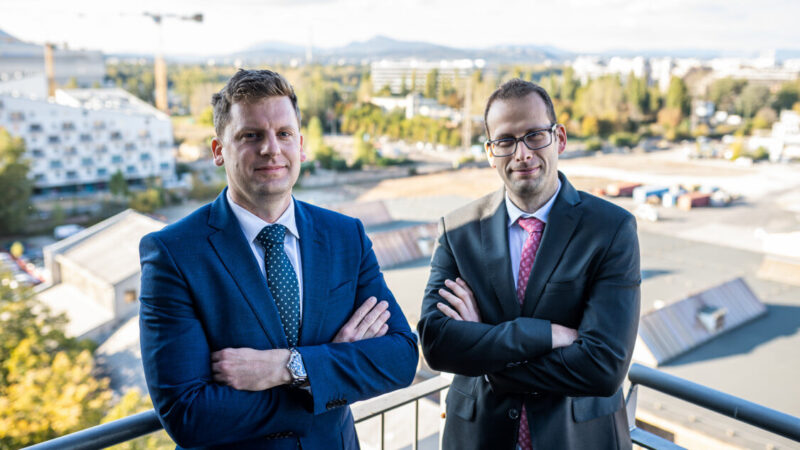
The world of business is about to undergo a major change, which could bring new directions in almost every area, from financial markets to supply chains and real estate. In the latter case, not only the transformation of the way people shop, work, live and travel, but also the economic processes and the regulatory environment are opening up new opportunities, some of them new obstacles, some of them unknown. We spoke to Ákos Boross, Managing Partner at Moore Hungary, and Gábor Pető, Head of Real Estate and Capital Markets Advisory, a new addition to Moore, and former Head of Real Estate Finance at UniCredit, about these complex economic and real estate market developments.
Moore has arrived in Hungary, which may not be news to many. How did the company start?
We have entered the Hungarian market as a new global brand. Moore is an Anglo-Saxon based network with a presence in over 110 countries, offering full global coverage in business and tax advisory, accounting, auditing, payroll and various business operations services. The Group now has a special focus on the Central and Eastern European (CEE) region, and with the quality assurance, infrastructure and expert team of a global organisation, we are able to provide our clients with complex and cross-border support in this highly competitive market. Our aim, and what distinguishes us from our competitors, is to provide a complex, cross-disciplinary and efficient solution, which is unique in the Hungarian market. This is supported by Gábor joining us. Gábor's background is special in the sense that he previously worked as a manager at a market leading bank for 15 years, he understands the internal processes and has a clear understanding of the bank's expectations, which enables us to provide more effective advice in a professional and timely manner.

What exactly does complexity mean? What can the consultancy cover from the perspective of, say, a company active in the real estate market?
We are able to bring together tax, corporate finance, banking, transactional and real estate experts in each area, so we can accompany the client from the very beginning of a transaction to the financial close, offering complex solutions, even across multiple jurisdictions. Typically, in this advisory segment we work on a transaction-related basis, helping our clients to find the best financing structure, for example, from classical financing to bonds or even the best equity solution. In addition, we are involved in a wide range of M&A transactions, from due diligence to closing and subsequent monitoring. The complexity of our services is illustrated by one of our current projects, where our client has real estate projects in several countries and we are now considering a „bundling” of the whole: we would transform the existing holding structure into a complex cross-border capital and financing structure with a more attractive portfolio approach, a modern financial and legal structure, which is also optimal from a tax perspective. We are proud to say that this year we have been involved in advising on a number of complex international hotel projects (from feasibility studies to repositioning to the development of the best hotel management structure).
Looking ahead, green finance and ESG is a key focus area, greatly helped by the strong knowledge base in Moore's network. Here we can talk about flagship projects such as Dallas Airport, the world's largest and the first carbon neutral airport in the US.
How healthy is the financing footing of the domestic real estate market? How are we doing on the green/not green ratio?
The local bond market, be it green or conventional bonds, is still very low by international standards as a share of GDP, although it has grown significantly through the NRP. Thus, there is still plenty of room for domestic companies, which the Magyar Nemzeti Bank has recognised by launching the Growth Bond Programme and later increasing the amount of the programme. Compared to the domestic stock, the stock of green bonds is indeed higher than the European average, but overall it is still negligible as a share of GDP.
Have you seen how the capital market rewards green projects with better interest rates in the short term?
In absolute terms, we expect these forms of financing to become increasingly attractive in terms of interest rates, but it is natural that the „green” conditionality will be tightened in parallel, in order to ensure that the preferential sources of finance materialise in carbon emission reductions with the best possible efficiency.
To reinforce this, there is a clear sense that the ECB will motivate banks to improve the environmental quality of their loan portfolios by offering capital benefits. Strong regulatory expectations on the one hand, and „cheapness” on the other, may spur loans that can be used for greening.
What exactly greening covers is another matter, but a precise and comprehensive definition is still to be found. At Moore, we are constantly monitoring and agreeing on draft regulatory changes and directions, so we can provide our clients with forward-looking solutions that take into account anticipated changes.
How modest is real estate financing for projects currently on the table?
Let's start with the largest segment, the office market. Today, it is not impossible to get a loan for an office building in a prime location without a pre-lease, but this of course requires a convincing risk balance between the players, which is also convincing for the bank. Otherwise, a well-rated developer with a well-leased building project is as attractive today as it was before the pandemic, and perhaps even better priced thanks to the abundance of liquidity. In the office market, demand has been minimally driven by home office, despite initial fears, and banks are sensing this and providing financing accordingly.
Moving on to the retail market, there is not much new real estate being built here (with the refreshing exception of Etele Plaza, or now the major renewal of Eurocenter). Acquisitions and refinancing of previous generation properties are somewhat more cautious, but we continue to see new leases. Those properties that have proven to be sufficiently viable during the more severe months of the epidemic can still be financed with appropriate conservative parameters. While we still do not expect a collapse wave due to the previous prudent financing structures and moratorium, a major tenant restructuring will clearly occur. Tenants are trying to manage hectic turnover, inflation fears and currency risk depending on their negotiating position.
In the logistics real estate market, everyone has added a shovelful on the financing and investment side, but many are concerned that the segment will not become overdeveloped. Based on the buildability of the plots purchased, our calculations suggest that if everyone starts building now, the area available for rent could double in a year's time. Such dynamics could be a problem, but fortunately developers are moving forward with prudence. Speculative financing is even less prevalent in this area, and so I think there is no cause for concern.
We are also fundamentally optimistic about the hotel market (ed: Moore has its own hotel team). Many well-positioned hotels - retaining their workforce - are already able to replicate pre-pandemic results, but obviously the recovery of the overall business tourism sector is a slightly more time-consuming process. Rural hotels that rely on leisure tourism are already outperforming 2019 numbers and this is not just a domestic phenomenon. It is interesting to note that many investors are waiting to buy hotels at a serious discount, but for the time being „vulture pricing” is not working for many of the reasons already mentioned (conservative banks, moratorium, subsidies, etc.) Of course, there are risks to the recovery due to the epidemic situation, which should definitely be mentioned. However, it is important to underline that the banks have learned their lesson in 2008 and know that the properties are not in the best hands with them, so in most cases they are looking for a common way out of the difficult situation by involving the existing owner. Even in difficult situations, a consultant with a good knowledge of the market can be of great added value, whether it is in repositioning the property or in professional mediation between owner and bank.
That sounds reassuring, although if I were a „vulture” I would be shedding a few tears of disappointment. Both pricing and financing are heavily influenced by the revenue-generating capacity of our existing assets or those under development. This is essentially a function of the revenue available. Have rental rates changed, and if so, how?
In the office market we see rents going up, to some extent tracking the rise in construction costs. It is true that new leases often reflect the uncertainties of the situation and are therefore more flexible (space give-back options, expansion options, shorter lease terms), but this does not shake the market for the reasons explained above. The dynamic rise in construction costs is even more likely to be mirrored in the logistics sector, where a significant increase in demand is also driving up prices. It has to be said, however, that domestic rental levels for this type of property are already above those experienced in Poland or the Czech Republic. Their fundamentals are nevertheless a cause for some concern. The retail property sector is where we see the most severe negative signs of a shift in rental conditions, but even these are generally within the tolerance of owners and banks.
The increase in rents is encouraging, but how will yields evolve in a situation where tenants are demanding increasingly flexible terms?
The office market has not changed much as liquidity remains abundant. However, it is perhaps even more accurate to say that there is a shortage of product, as there are minimal new projects and investors are holding on to older product.
It should be stressed that logistics yields are already very close to those experienced in the office market. This trend had already been observed to a small extent before the pandemic, but since last year the gap has been closing more and more dynamically.
The opposite is true for retail market returns. They are becoming increasingly disconnected from the other segments, there are very few retail transactions in the region - and most of them are domestic acquisitions - and international investors are cautious about this sector.
What can be done if there are serious problems with the creditworthiness of firms?
Our team has significant references and complex advisory experience in the restructuring market, both for individual large projects and portfolios, as well as for post-restructuring assignments. The expiry of the moratorium may be a problem in some projects and the owner may not want to sell the property cheaply, in which case we can help, either on the banking or the tax side. There may be transactions where an unsustainable financing structure will require restructuring or the involvement of an investor, possibly refinancing or sale. We would like to emphasise that we do not recommend waiting for a conflict situation, timely action is key, and in these cases we can most effectively put in place a sustainable long-term financing structure. Fortunately, the markets offer a range of possible solutions, whether it is a temporary subordinated loan or a classic restructuring, where a neutral party with a good understanding of the external market can add significant value.
Now there is money, and there is pressure from investors and creditors. Are the conservative big banks moving towards alternative products?
There is a lot of pressure on banks not to reduce their balance sheet total and market share, but there is also huge pressure on profitability and long-term predictability. These are balanced to some extent.
The focus is on those products that offer a good risk-adjusted return in the long run, but Hungarian banks are not going in exotic directions just because there is a need to outsource.
What are the main advisory roles you expect to play in the real estate market in the coming years?
In many ways, the business world is also facing a very big change, whether from a real estate, supply chain or financial markets perspective. The office segment may be transformed by the significant uptake of the home office, not necessarily in terms of office occupancy, but in terms of how it is designed to meet the challenges of the new era. There are many articles available on how to design a workspace that is conducive to constructive working. The explosion of e-commerce and the need to stock closer to the consumer, driven by the fragmentation of supply chains, has generated huge changes in the industrial property market. Turning to the bond market, the Fed has announced that it is slowly phasing out asset purchase programmes, which will gradually shift funding away from the bond side and back to banks. From the above, it is clear that there are plenty of challenges, or optimistic opportunities, which a well-prepared advisory team can help to maximise.
Moore Hungary
Moore Global, which started in a London office more than 110 years ago, is now one of the world's leading consulting and audit networks. Present in over 100 countries worldwide, the network has more than 600 independent offices and over 30,000 employees. The group's turnover for the last financial year exceeded $3 billion.
Moore Global's services will be directly available in the domestic market from March 2021. Moore Hungary has been offering a full range of consulting services in the fields of business, financial, tax, accounting and auditing with a team of almost 100 experts since its inception.
In our fast-changing world, Moore provides strategic guidance and practical advice to help clients navigate and understand the complex regulatory and changing market environment and industry conditions, and thereby find the best solutions.
Follow us on LinkedIn for more news!