





Domestic hotels can close an outstanding summer even with higher room rates
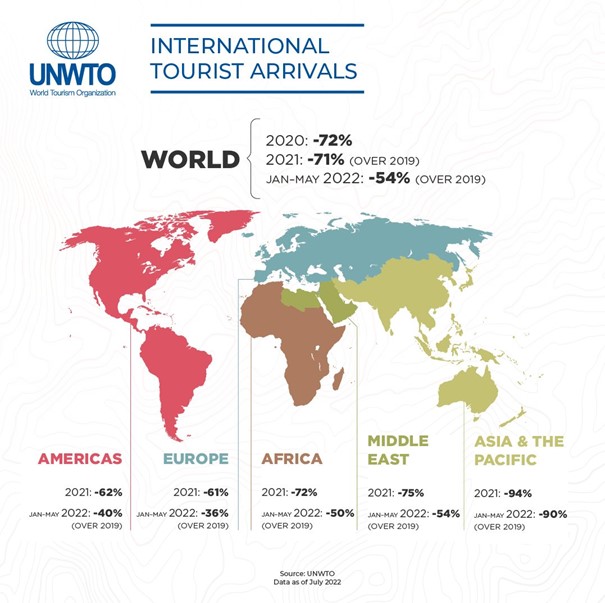
In the first five months of the year, Europe's tourist arrivals were 350 per cent up on a year earlier, according to the latest figures from the United Nations World Tourism Organisation (UNWTO). Neither the economic problems, nor the chaos at airports, nor the uncertainty caused by the war in Ukraine, can dampen demand for travel, as shown by the fact that the average occupancy rate on the continent had risen to 70 per cent by May.
„Domestic hotels with a significant occupancy rate, and at unprecedented price levels which also allows them to pass on their increased costs in their prices - points out Márton Takács, Global Head of Moore's Global Hotel and Tourism team. - Thanks mainly to this year's increases, domestic hotel room rates in May were 22 percent higher than in May 2019, with 13 percent in Budapest and 28 percent in the Balaton region.”
Preliminary data show that domestic visitors are not deterred by increased costs in the summer period, as for the time being, strong travel demand following restrictions in previous years continues to override everything. Market indications are that accommodation in both Budapest and the countryside will certainly be operating at record prices until the end of September. At the same time, operators in this country - as in the rest of Europe - are anxiously awaiting the winter months to see how operating costs will develop. However, it is fair to say that the long-term market fundamentals remain strong and international investor confidence in the sector remains undiminished.
Travel has picked up around the world
Although the four and a half times the number of tourist arrivals in Europe is a global highlight, the tourism industry is also growing rapidly on other continents. The Middle East recorded a 157 per cent increase in tourist arrivals, Africa 156 per cent, the Americas +112 per cent and Asia Pacific +94 per cent year-on-year between January and May. Asia to this day serious restrictions are in force, these are future mitigation could provide a significant additional boost the tourism industry in the region.
Of course, the picture also includes the fact that there is still a huge gap compared to 2019, the year before the crown virus outbreak. Worldwide tourist arrivals between January and May this year was still 54 percent lower, Europe is also performing exceptionally well in this respect, with the continent's tourism backlog now only 36 per cent, making the recovery in tourism the most spectacular so far.
„The picture is further complicated by the fact that the distribution of demand is certainly not even within Europe: international tourist arrivals from countries neighbouring Ukraine are proportionally lower than from key markets such as France and Spain. In Hungary, domestic demand continues to be the most dominant in the priority holiday destinations. This effect was significantly reinforced by the fact that the rise in the forint exchange rate to over 400 forints has led many people to switch from foreign to domestic destinations” - added Márton Takács.
Moore Hungary
Moore Global, which started in a London office more than 110 years ago, is now one of the world's leading consulting and audit networks. Present in over 100 countries worldwide, the network has more than 600 independent offices and over 30,000 employees. The group's turnover for the last financial year exceeded $3 billion.
Moore Global's services will be directly available in the domestic market from March 2021. Moore Hungary has been offering a full range of consulting services in the fields of business, financial, tax, accounting and auditing with a team of almost 100 experts since its inception.
In our fast-changing world, Moore provides strategic guidance and practical advice to help clients navigate and understand the complex regulatory and changing market environment and industry conditions, and thereby find the best solutions.
Follow us on LinkedIn for more news!