





The „invisible” values are essential to help companies develop further
More measurable efficiency, significantly improved financing and investment opportunities, and in the case of an acquisition, the possibility of achieving a multiple premium - these are some of the benefits that justify the definition of brand equity and its inclusion in the balance sheet, Moore Hungary points out.
Today Kantar published its latest ranking (Kantar BrandZ) of the world's most valuable brands. Despite the fact that the share prices of the technology stocks that make up the majority of the most valuable brands - including their brand value - have been battered by the stock market turmoil of the past year, it was not possible to make the TOP 10 this year with a brand value of less than $100 billion. The 100 most valuable brands are worth 20 percent, or $1,700 billion less today than a year ago, but up 47 percent from pre-COVID 2019 levels.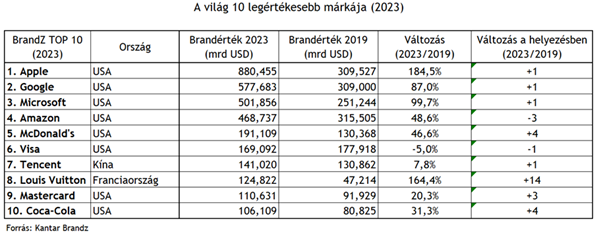
For the second year in a row, Apple has been at the top of the Kantar Brandz ranking, with Amazon gradually slipping from first to fourth place compared to 2019. Among non-technology companies, McDonald's is the most valuable, and Coca-Cola, which is bucking the trends this year, is back in the top 10 for 2023. The predominance of US companies continues to dominate the brand value list, with 8 of the 10 most valuable brands coming from the US. (The same proportion was true in 2019, when the French Louis Vuitton was replaced by the Chinese Alibaba in the top 10.)
A major advantage in many respects
But brand equity is not only a priority for leading global companies.
Under the current tight bank financing conditions, the further development or even longer-term survival of a company may well depend on its ability to access additional funding. On the balance sheet brand equity as an intangible right is also of great importance in this respect, since can significantly improve a company's equity/debt ratio, which is a key criterion for financiers when determining creditworthiness.
Brand equity also plays a fundamental role in the operation of a company in the event of a change of ownership. The takeovers history clearly shows that in some cases, buyers may even pay most of the transaction value to the for the acquisition of a successful brand are paid.
„The brand equity recognised as an intangible right can also play an important role in the operation of controlling systems and tax planning. The brand name can also be an important tool to assess the effectiveness of a company, as it can measure the proper allocation of resources and the effectiveness of management.” - emphasises Gabriella Huth, Managing Partner of Moore Hungary.
| How is brand equity calculated?The methods used in international practice approach brand equity, which at first glance seems very subjective, from a number of different angles. Mostly used for verification purposes only cost-based assessment examines the costs associated with the development of a brand name, while other methods look at the costs associated with the generated additional income are calculated. The market comparison methods at the same time, they are able to visualise the value of the brand, for example by analysing the price advantage of branded products, or by examining the amount of transactions and royalties paid for the brand. |
„In business, defining brand equity is very important - points out Ákos Boross, Managing Partner of Moore Hungary. – In addition to the increase in fundraising and financing opportunities, it is also important to mention the sponsorship practices in the sport and culture sector, or even the replacement of corporate brand names or logos related to products and services. In each of these cases, a good understanding of the value of the brand is a prerequisite for the cost-benefit analysis of the planned actions.”
Moore Hungary
Moore Global, which started in a London office more than 110 years ago, is now one of the world's leading consulting and audit networks. Present in over 100 countries worldwide, the network has more than 600 independent offices and over 30,000 employees. The group's turnover for the last financial year exceeded $3 billion.
Moore Global's services will be directly available in the domestic market from March 2021. Moore Hungary has been offering a full range of consulting services in the fields of business, financial, tax, accounting and auditing with a team of almost 100 experts since its inception.
In our fast-changing world, Moore provides strategic guidance and practical advice to help clients navigate and understand the complex regulatory and changing market environment and industry conditions, and thereby find the best solutions.
Follow us on LinkedIn for more news!