





69 percent see full transfer of management as problematic
81% of family business owners want to make a generational change by retaining ownership, according to a joint survey by Moore Hungary and Opten. Selling the business on the right terms is considered the best option by only 14 percent of owners.
A significant proportion of Hungarian family businesses were founded in the 1990s and are very often still headed by their founding owners, who are likely to be well over retirement age. Market estimates suggest that nearly half of family businesses the current problem of generational change, but the process is often very slow, if it gets off the ground at all. A joint survey conducted by Moore Hungary and Opten in July to find out the reasons for this can help to uncover the transfer plans of the managers concerned.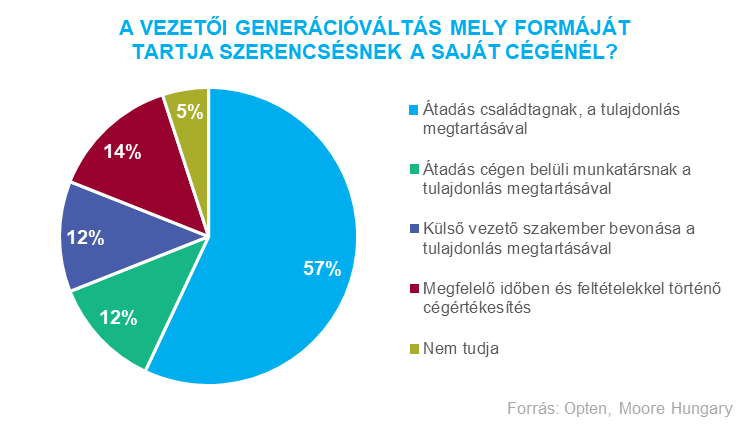
Among those who are thinking about keeping the property later, the leadership most people would hand it over to a family member (57%), while others consider the involvement of an internal employee or external manager (12-12%) to be the best scenario at the right time.
„Very low, only 14 per cent of those who would reap the rewards of their work by selling their company - points out Gabriella Huth, Managing Partner of Moore Hungary. This attachment to the company is understandable from an emotional point of view, but at the same time in many cases, such as when market conditions change, the ideal step is often a partial or complete sale would be. However, the development of the right conditions for such a move should start in good time. In any case, the company should be prepared for the sale, which can significantly increase the selling price.”
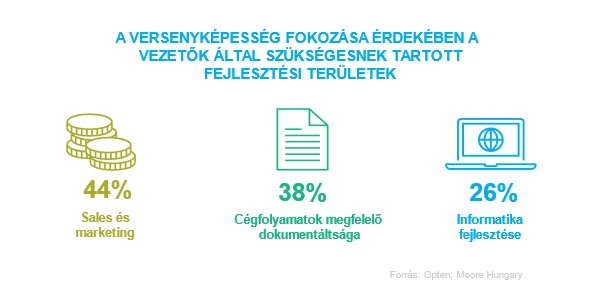
In response to the question of where they see the need to improve competitiveness, including in order to improve the conditions for a future sale, the following areas are considered necessary developments the owners, most of them (44%) are sales, marketing activities have been nominated. Many also consider it important to improving the proper documentation of company processes (38%), and the IT developments (26%). Moore Hungary's experience so far shows that the costs of these improvements are recovered many times over in the sale/acquisition of a company.
Should the owner decide to engage an external management expert, only 17% would delegate full management. The majority would hand over operational management positions (72%) or other areas (such as financial management) to a new manager. 31% of owners would prefer not to hand over all responsibilities trust-related problems are reluctant to do so. 25 percent of them are fear of a wrong turn their company, and 11 percent the source of many serious conflicts sees a risk in such a move.
The ideal new CEO
If a new CEO is appointed, respondents were almost unanimous that experience in the company's field of expertise are considered the most important aspect. The second most important aspect for family businesses is personal acquaintance: 75 percent of respondents considers this to be decisive. A person within the company 67 percent consider age a relevant criterion, and 64 percent consider age an important indicator. The ideal candidate age usually between 35-50 years is still dynamic enough, but has already gained some serious work experience.
Respondents' views completely split (50-50%) on whether an external consultancy should help prepare for an effective generational change or not. Those who consider it advisable to have an objective, external expert present in the process, when selecting the consultant industry experience as a primary consideration (84%) and it was also considered important that the consultant be a company with a domestic background (75%).
„The current survey is a repeat of our research from three years ago - explains Dr. Hajnalka Csorbai - Strategic Director of Opten Informatikai Kft. We did not see a significant shift compared to the values measured then, the big difference being that the CEOs concerned have since become an additional three years older. This increases the need to prepare for generational change, as it is much more difficult to find and take the ideal steps for the future of the company in unexpected situations.”
To sum up: unfortunately, the attitude of business owners towards generational change has not changed in Hungary in the last 3 years. Surprisingly, Covid has not caused a real breakthrough in thinking either. Generational change is a real problem among us, and if it is not forced but part of a well-constructed process, experience shows that everyone can come out of it as winners. - the experts stress.
Moore Hungary
Moore Global, which started in a London office more than 110 years ago, is now one of the world's leading consulting and audit networks. Present in over 100 countries worldwide, the network has more than 600 independent offices and over 30,000 employees. The group's turnover for the last financial year exceeded $3 billion.
Moore Global's services will be directly available in the domestic market from March 2021. Moore Hungary has been offering a full range of consulting services in the fields of business, financial, tax, accounting and auditing with a team of almost 100 experts since its inception.
In our fast-changing world, Moore provides strategic guidance and practical advice to help clients navigate and understand the complex regulatory and changing market environment and industry conditions, and thereby find the best solutions.
Follow us on LinkedIn for more news!